Square and Rectangular Wooden Gazebos

Some gardens have a shape of their own: a wall that runs the length of the plot, a patio laid square to the house, a terrace that ends where the lawn begins. A square or rectangular gazebo follows those lines instead of interrupting them — which is why it is usually the calmest choice for a garden that is already ordered.

Within this collection, the decision is about proportion rather than shape. A square concentrates everything around a centre point, while a rectangle lets you run a table or a bench along one axis. Browse the models below to compare footprints, proportions and pricing, with delivery arranged for every order and installation support depending on the project.

Explore the Square & Rectangular Gazebo Models

Why Choose a Square or Rectangular Gazebo?

A squared footprint follows the geometry a garden already has: the wall of the house, the fence line, the edge of a patio. Instead of introducing a new shape into the plan, it extends the lines that are already there — which is why straight-sided gazebos are usually the easiest to place and the easiest to furnish.

It Follows the Lines of the Plot

Against a house wall, along a fence or across a rectangular patio, a square or rectangular gazebo lines up with what is already there, so the garden keeps a clean, ordered layout.

It Creates an Obvious Place for a Table

Straight sides and a regular plan give a dining table a natural position, with room to pull chairs back and still move around it.

It Is Easy to Place Against a Boundary

When the gazebo needs to sit near a fence, wall or hedge, straight sides make the alignment simple to plan and the footprint predictable to measure.

Square or Rectangular: How the Footprint Changes the Layout

This is the decision that matters most within the collection, and it is about proportion rather than shape. A square concentrates seating around a centre point, so the space is used from every direction. A rectangle lets you run a long table or a line of seating along one axis — which is what most dining layouts actually need.

When a Square Footprint Works Best

Patios laid square to the house, courtyard corners and symmetric plots. A square suits seating arranged around a centre — a table with chairs on each side, or a lounge set that is used from every direction.

When a Rectangle Works Best

Alongside a house wall, along a long boundary, or over a rectangular terrace. A rectangle suits a long table, a run of benches or defined zones — seating at one end and open space at the other.

Where a Square or Rectangular Gazebo Works in a UK Garden

Placement decides how often the space actually gets used. Before you shortlist models, work out how the gazebo will sit relative to the house, the view and the direction of the wind — and which of the four situations below is closest to yours.

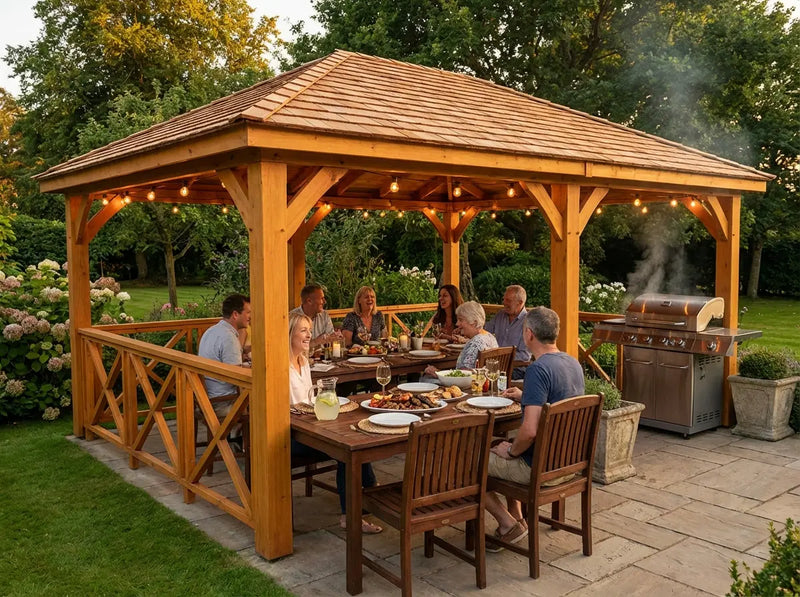
Rectangular wooden gazebo over an outdoor dining set

Outdoor Dining and Entertaining

A rectangular footprint gives the most straightforward setup for a table, chairs and circulation space. Work from the doors outwards: keep the route from kitchen to table clear, and check which way the evening sun falls before fixing the position.

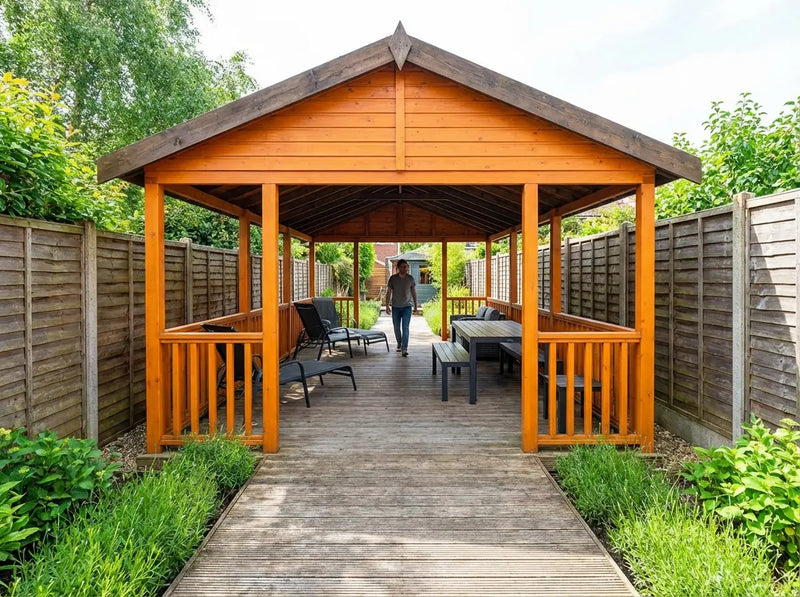
Rectangular wooden gazebo along a long patio

Long Patios, Decking and Narrow Gardens

Where a wide shape would feel cramped or leave unused corners, a rectangle follows the run of the space. It lines up with decking boards and patio edges instead of cutting across them.

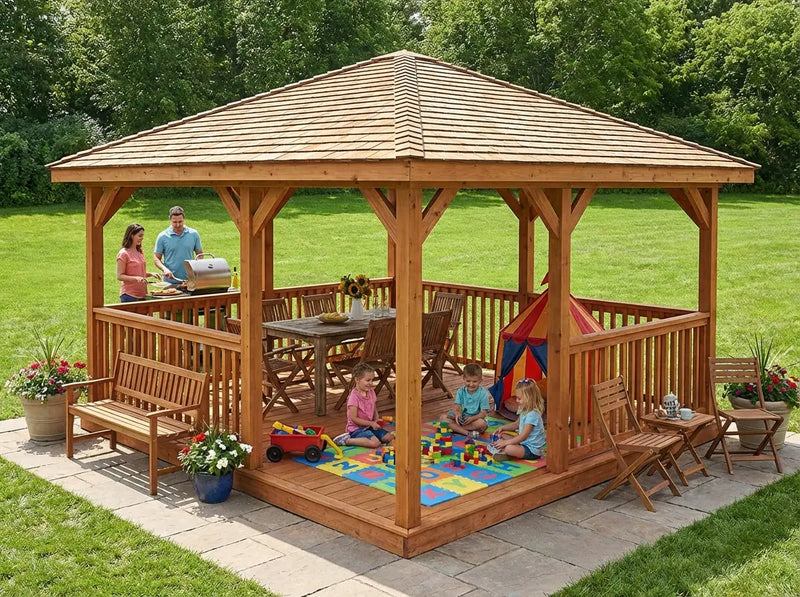
Square wooden gazebo used as flexible family space

Flexible Family Space

A square gazebo works as a general-purpose shelter: dining one day, lounging the next, the children's games in between. The regular plan makes it easy to rearrange furniture as the seasons change.

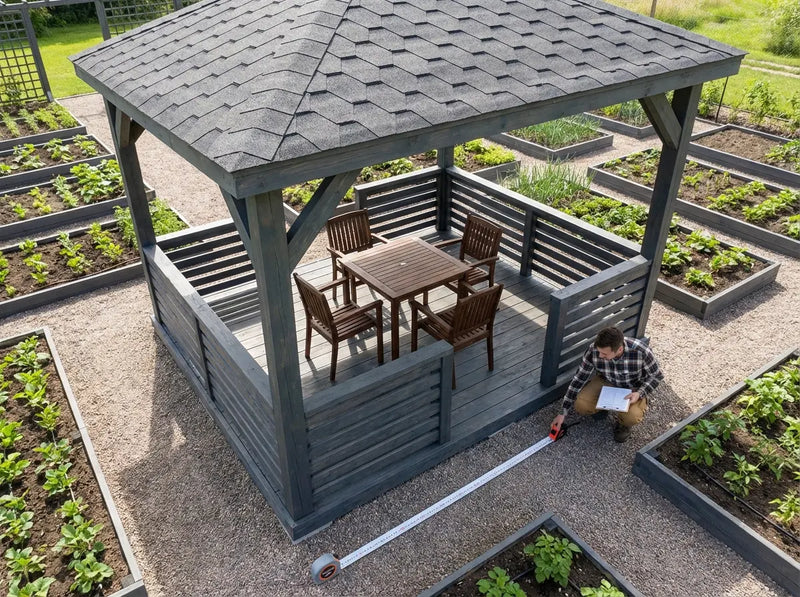
Square wooden gazebo framing a garden view

Framing a View or a Terrace

Alignment is the design decision: line the gazebo up with the house or a boundary, or open it towards the view. Check the direction of the prevailing wind too, because it decides how sheltered the seating will feel.

Roof Styles and Orientation: Questions to Ask

The roof range differs from model to model, so treat this as the set of questions to ask rather than a description of the options — the specification for each gazebo is confirmed on its product page:

Covering

What the roof is made of, how the edges are finished, and what it does in heavy rain. Confirm the specification on the individual product page.

Shape and Pitch

Which models keep a straight roof line rather than a pyramidal profile, and what pitch each uses. The answer affects both the look and how the roof sits against a wall or boundary.

Orientation and Light

Which way the open sides should face — towards the house, the view or the evening sun. Orientation is easier to settle before you order than after, so raise it in the consultation.

Choosing a Size: Four Steps

Footprints vary from model to model, and each product page carries the exact dimensions for that gazebo. Use these four steps to narrow the grid before you compare the individual pages:

1. Measure the Space, Then the Furniture

Measure the patio, terrace or lawn you have, then the table and chairs that need to fit underneath — pulled-back chairs included. The gazebo has to clear the furniture with room to move, not just fit the garden.

2. Check Orientation, Access and Walkways

Consider where people will approach from — house doors, patio steps, paths — and keep the main access clear. In many gardens, placing the gazebo parallel to the house or patio creates the most natural flow.

3. Match the Proportion to the Plan

A centred, symmetric plan points to a square; a long axis along a patio or wall points to a rectangle. The layout section above explains the difference in detail.

4. Compare Footprints in the Grid

Every model in the grid links to a product page carrying its own dimensions and specification. If the size you need is not listed, custom sizes are available — what can be adapted is confirmed with you before a quote.

What to Prepare Before You Order

The base and the site come before the structure. A gazebo needs level, stable ground, and the site needs to be reachable for delivery — access paths, gates and parking are all worth checking before you order. Where the structure will sit relative to your boundaries affects both everyday use and the planning rules that apply to you.

If you already have a base, tell us what it is; if not, we will advise on preparation for your ground before anything is confirmed. For a full walkthrough of what happens after you order — delivery, access and installation — see our guide to how delivery and installation work.

Related Shapes & Guides

Still Comparing? Here Is Where to Look Next

If a squared footprint turns out not to be right for your garden, the related collection cards below take you to the hexagonal and octagonal shapes — and the all wooden gazebo collections hub lets you compare every shape in one view.

For the full decision process — shape, siting and layout — our guide to choosing between gazebo shapes walks through it step by step.

Frequently Asked Questions

Is a square or a rectangular gazebo better?

Neither, in the abstract — it depends on the plot and the seating. A square concentrates seating around a centre point and suits symmetric plots and courtyard corners. A rectangle runs a long table or a line of seating along one axis, which suits patios, terraces and boundaries. If you send us the dimensions of your space, we will help you narrow it down.

Will a rectangular gazebo fit along my boundary?

Measure the run you have, then leave an allowance for access and maintenance — you will still need to reach the fence or wall to treat it and keep it clean. Structures close to a boundary are also where the planning rules start to apply, so check the official guidance for your situation rather than relying on a rule of thumb; the question below covers the basics.

Can I put a square gazebo on a patio?

In principle, yes — a level patio can make a good base for a gazebo, subject to the base requirement for the model and a suitable fixing method. Whether a particular design can be fixed to a hard surface is confirmed with you before you order, because it depends on both the model and the patio itself.

Do I need planning permission for a gazebo?

Often no, but not always: height limits near boundaries, garden coverage and siting rules all apply, and they differ by nation and local authority. The fuller answer lives in the planning FAQ on our gazebo hub, and the Planning Portal outbuildings guide carries the official detail.

What base does a square or rectangular gazebo need?

Every gazebo needs a level, stable base, and the exact requirement is set out on the individual product page rather than generalised here. If you already have a patio, deck or concrete pad, tell us what it is and we will confirm what preparation, if any, it needs before you order.

Explore Related Gazebo Collections

Each collection focuses on one shape family. If a squared footprint is not quite right for your garden, hexagonal and octagonal designs give you a centred seating circle and a more formal look, while the custom-made collection covers footprints the standard shapes do not.

Ready to Plan Your Square or Rectangular Gazebo?

Working to a fixed footprint? Tell us the dimensions of the space you have, and we will help you narrow the collection to the proportions that fit.